These two sheets show the same product at two levels. The first is the ratchet buckle as a component: nine references in three frame sizes, each with its own handle material and rated breaking strength. The second is the finished tie down as it is shipped: webbing already threaded through the buckle, hooks crimped on both ends, wound into a coil and labelled. Buyers usually need both views, because the buckle decides how the assembly feels in the hand, while the assembly decides what the load can actually take. Read together, the sheets answer the three questions that come up in almost every enquiry: which frame size, which handle, and which complete model.
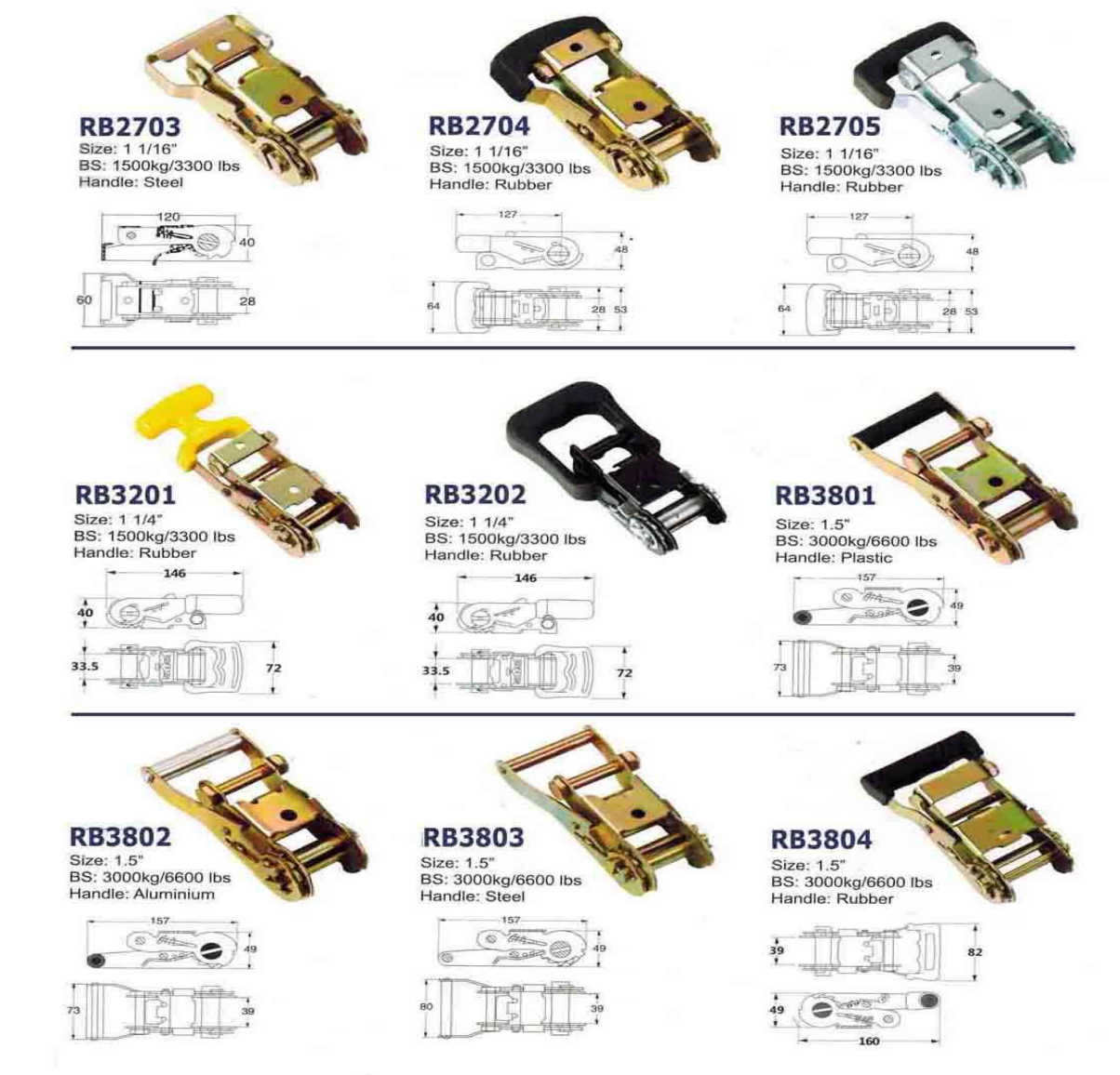
1 The buckle range: three frames, four handle materials
All nine buckles fall into three frame widths. The 1-1/16 inch group (about 27 mm) contains RB2703, RB2704 and RB2705, each rated 1500 kg / 3300 lbs. RB2703 uses a steel handle on a 120 mm frame; RB2704 and RB2705 move to a 127 mm frame with a rubber grip, and RB2705 is the version to specify when the strap is handled all day, because the grip spreads pressure across the palm instead of concentrating it on a narrow steel bar. The 1-1/4 inch group (about 32 mm) adds RB3201 and RB3202, both 146 mm frames rated 1500 kg / 3300 lbs, one with a yellow T-shaped rubber handle and one with a black loop handle. The 1.5 inch group (38 mm) is where the range steps up to 3000 kg / 6600 lbs: RB3801, RB3802, RB3803 and RB3804 share a 157 to 160 mm frame and differ mainly in handle material — plastic, aluminium, steel and rubber respectively. That single variable matters more than it looks. Steel and aluminium handles survive rough loading docks and stay stiff under a hard pull; rubber and plastic are lighter and kinder to bare hands on repetitive work. For a fleet that leaves straps on the truck, choose metal. For a warehouse that tensions by hand every day, choose rubber.
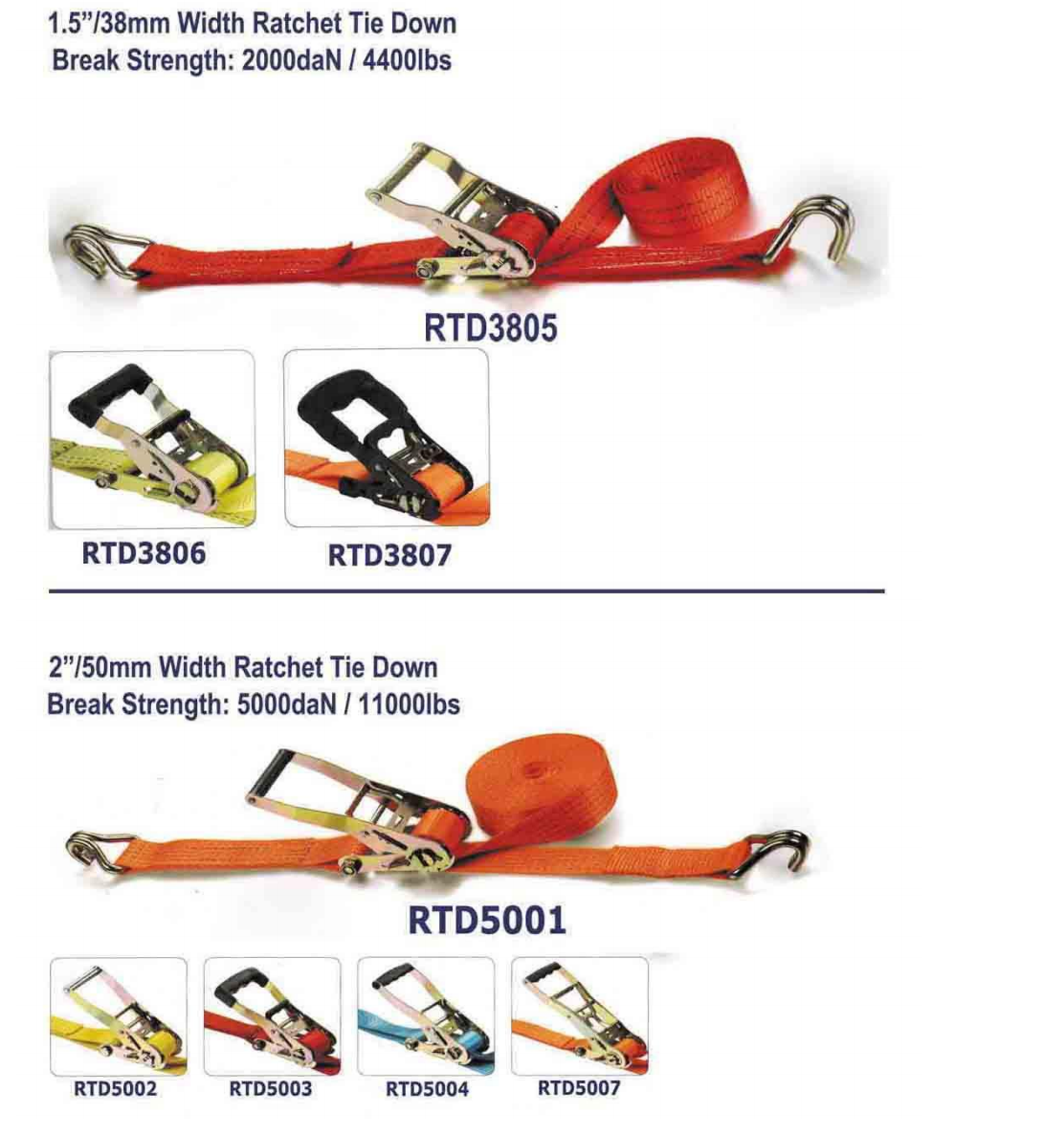
2 The complete assemblies: two width classes
The second sheet moves from components to finished products, and it is organised by two break strengths rather than by frame size. The 1.5 inch / 38 mm class is rated 2000 daN / 4400 lbs, roughly two tonnes of breaking strength, and covers RTD3805 in red with double J hooks, RTD3806 in yellow and RTD3807 in orange with their own handle and hook combinations. The 2 inch / 50 mm class is rated 5000 daN / 11000 lbs, roughly five tonnes, and runs from RTD5001 in orange through RTD5002 in yellow, RTD5003 in red, RTD5004 in blue and RTD5007 in orange. The colour difference is not decoration: it lets a depot assign one colour per trailer, per customer or per load type, so a strap that comes back damaged can be traced to the route it worked. Every assembly in both classes uses the same construction logic — a tight-weave webbing, a ratchet frame matched to the webbing width, and hooks at both ends — so the choice inside a class comes down to colour, hook type and handle.
JahooPak Ratchet Tie Down Specification
| Width | Length | Color | MBS | Joint Strength | System Strength | Max Securing Load | Certificate |
|---|---|---|---|---|---|---|---|
| 32 mm | 250 m | White | 4200 lbs | 3150 lbs | 4000 daN / 9000 lbF | 2000 daN / 4500 lbF | AAR L5 |
| 230 m | 3285 lbs | 2464 lbs | - | - | AAR L4 | ||
| 40 mm | 200 m | 7700 lbs | 5775 lbs | 6000 daN / 6740 lbF | 3000 daN / 6750 lbF | AAR L6 | |
| Orange | 11000 lbs | 8250 lbs | 4250 daN / 9550 lbF | 4250 daN / 9550 lbF | AAR L7 |
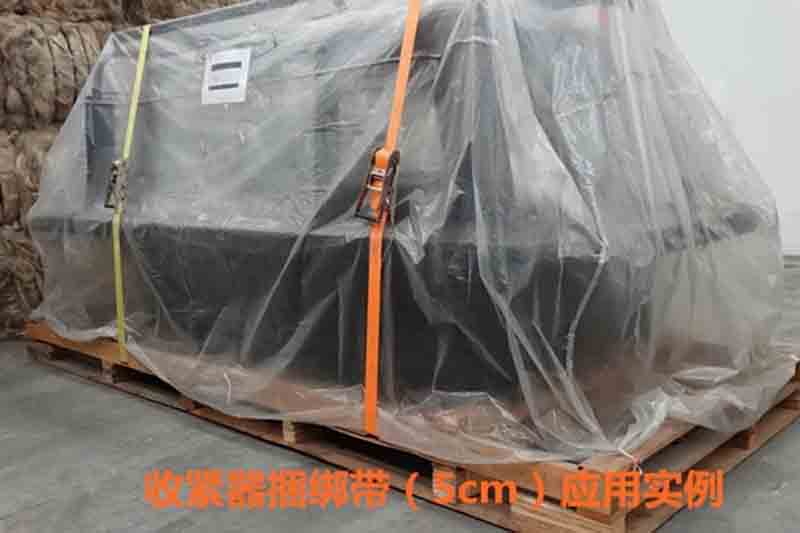
JahooPak Strap Band Application
- Prepare & Secure
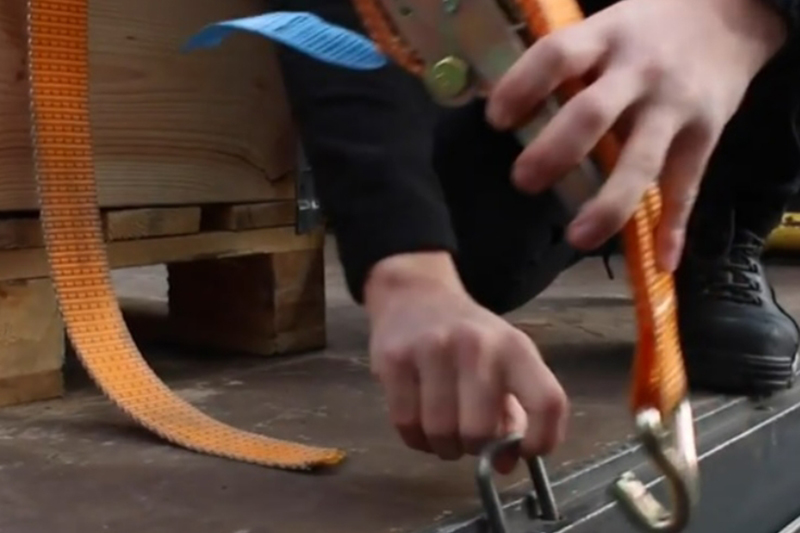
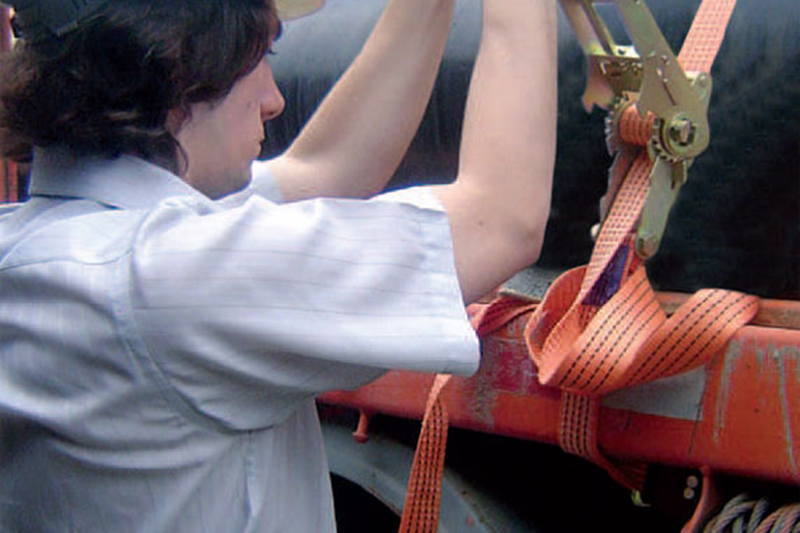
Disengage the spring catch to open the ratchet buckle, then route the heavy-duty webbing over or through your cargo and attach the end hooks to solid anchor points.
- Feed & Pre-Tighten
Pass the free end of the strap through the slotted center axle of the ratchet and pull snug before ratcheting.
- Ratchet to Lock
Operate the ergonomic handle up and down; the one-way locking gear builds high tension smoothly without slipping back.
- Effortless Unloading
Simply squeeze the release trigger to disengage the locking pawl, flip the handle fully open (180 degrees), and pull the strap free.