

Product Overview
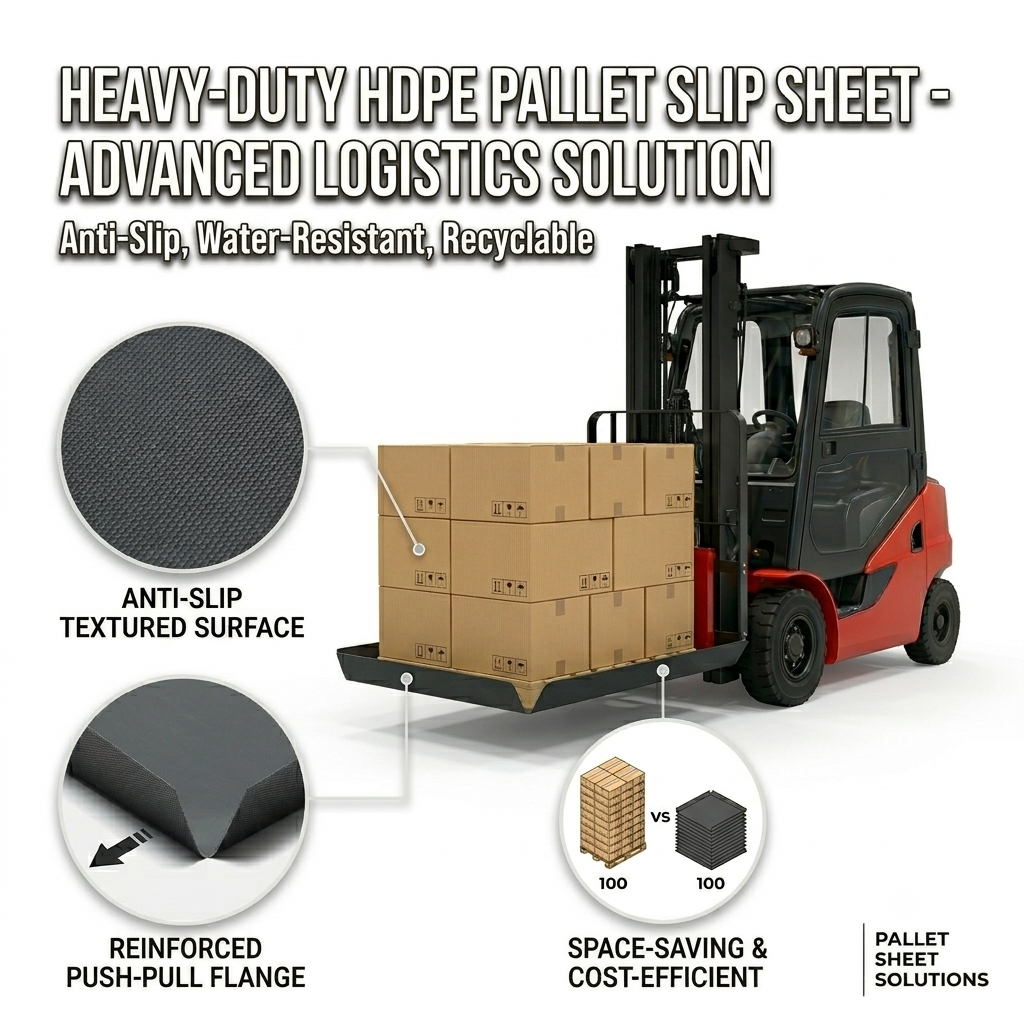
JahooPak Plastic Slip Sheets are a lightweight, pallet-free base for unit loads handled by forklifts with push-pull attachments. Made from high-density polyethylene (HDPE) or polypropylene (PP), each sheet is placed under a stacked load and pulled onto the forklift platform by its extended tab, then pushed off at the destination. Compared with wooden pallets, slip sheets add almost no height or weight to the load, are not subject to ISPM 15 wood treatment requirements, and help exporters use more of the available container space. They are widely used for cartoned goods, bagged products and clean-industry shipments in warehouses, distribution centers and export operations.
Key Features & Benefits
✓
Pallet-free efficiencyA fraction of the weight and height of a wooden pallet, increasing usable container volume and reducing deadweight on every shipment.
✓
No ISPM 15 treatment neededAs a plastic packaging material, the sheet avoids timber heat-treatment, fumigation and marking requirements for international shipments.
✓
Push-pull compatibleExtended tabs and optional folded edges give the attachment a secure grip, supporting smooth pull–carry–push handling cycles.
✓
Clean and safeNo splinters, nails, dust or pest risk — suitable for food, pharmaceutical and electronics loads where timber pallets are undesirable.
✓
Custom-built for your loadSheet size, thickness, material grade, tab length and tab configuration can be matched to your carton footprint, load weight and handling equipment.
✓
Reusable or one-wayHeavy-gauge sheets support closed-loop reuse; lighter sheets are economical for single-trip exports where pallet return is not practical.
✓
Recyclable materialHDPE and PP sheets can be recycled at the end of their service life, supporting greener packaging programs.
Typical Applications
Plastic slip sheets are used wherever stable unit loads need to move efficiently through storage and transport. Common applications include cartoned food and beverages, household goods, industrial parts, bagged grains, fertilizers and powders, as well as electronics and automotive components. They are especially valuable in container loading: the low profile of the sheet allows more product per container, and the absence of timber simplifies export paperwork and customs clearance in markets with strict wood-packaging controls. In clean warehouses, the smooth, splinter-free surface also helps protect both goods and handling staff.
Specifications
| Item | Options |
|---|---|
| Material | HDPE or PP |
| Standard colors | Black (other colors available on request) |
| Sheet thickness | Customizable to load requirement |
| Sheet size | Matched to carton footprint or pallet size; custom dimensions available |
| Tab design | Extended tab, multi-tab or folded-edge configurations |
| Surface | Standard or anti-slip finish |
| Use mode | Single-trip / reusable |
| Test documentation | Material test reports available on request |
Customization & OEM Service
There is no single slip sheet that fits every load. JahooPak engineers each specification around the cargo: length and width are matched to the carton layout or container plan; thickness and material grade are selected for the load weight and stacking pattern; tab length, tab position and edge design are adapted to the push-pull attachment in use. Anti-slip treatment and special corner construction can be added for unstable or heavy loads. OEM orders, custom colors and customer-specific labeling are supported. Send us your cargo dimensions, load weight, current pallet size, container type and handling equipment, and we will recommend a suitable specification and provide samples for testing.
How It Works
- Position the slip sheet under the load, with the tab facing the forklift.
- The push-pull attachment grips the tab and draws the whole load onto its platform.
- Transport the load to the storage area, production line or container.
- The attachment pushes the load off, leaving the sheet at the base of the stack.
Standard forklifts can be fitted with a push-pull attachment, and operators usually need only brief training to master the cycle. For export shipments, the empty sheets can be folded flat and stored compactly before use.
Products categories
-

Cost-Effective Slip Sheet Alternative to Wood P...
-

High Quality 1.2mm Plastic slip Sheet for Shipp...
-

Multipurpose 0.6mm Disposable Push Pull Heavy D...
-

2025 Store Promotion 1.5mm Recyclable Paper Pal...
-

Customizable Kraft Paper Slip Sheet with Push-P...
-

Solve Warehouse Congestion with Our Stackable S...


