
Jiangxi JahooPak Co., Ltd., a supplier of cargo securing and transportation packaging solutions, today highlighted the growing adoption of plastic slip sheets as a practical, cost-effective alternative to wooden pallets in containerized export shipments and high-volume warehouse operations.
As freight costs, timber regulations and warehouse space pressures continue to shape logistics decisions, exporters are re-examining the unit load. A plastic slip sheet is a thin, flat sheet of high-density polyethylene (HDPE) or polypropylene (PP) placed beneath a stacked load. Used with a forklift fitted with a push-pull attachment, it forms a low-profile, pallet-free base that can be pulled, transported and pushed off at the destination.
Why Companies Are Replacing Wooden Pallets
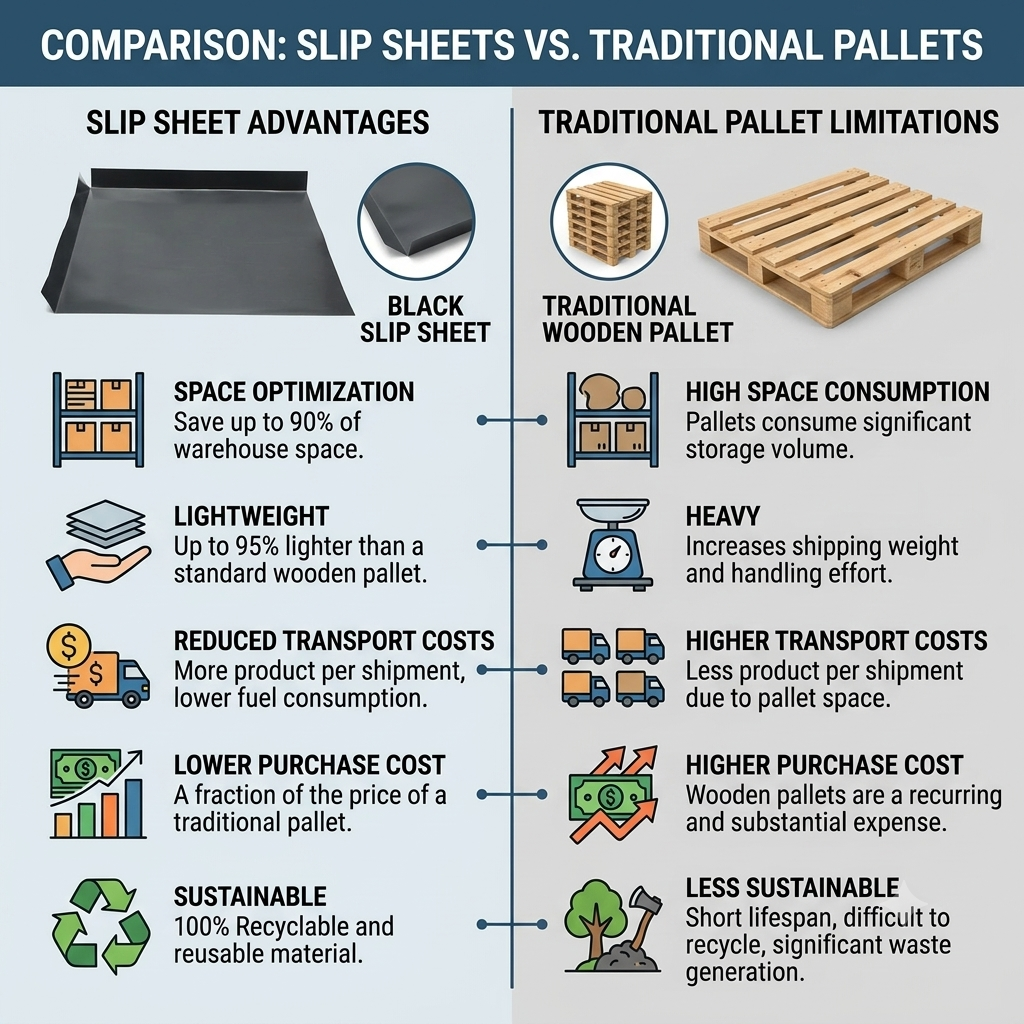
Wooden pallets remain the default unit load in many industries, but they bring well-known costs: significant weight and height inside a container, the need for heat treatment or fumigation under ISPM 15 for international shipments, and ongoing expenses for repair, storage and return logistics.
Plastic slip sheets address each of these issues. Depending on size and thickness, a single sheet weighs only a fraction of a wooden pallet, freeing up payload and usable container volume. Because plastic is not wood packaging material, slip sheets are not subject to ISPM 15 treatment and marking requirements, which can simplify export documentation and reduce delays at destination ports.
For clean environments — including food processing, pharmaceuticals and electronics — slip sheets also avoid the splinters, nails, dust and pest concerns associated with timber. For one-way export shipments, they eliminate the cost of returning pallets home.
How Push-Pull Handling Works
The handling principle is straightforward. A forklift equipped with a push-pull attachment grips the extended tab or folded edge of the slip sheet, draws the entire load onto the attachment’s platform, carries it to the target position, and then pushes the load off onto the floor, a rack or another sheet.
Most standard forklifts can be retrofitted with a push-pull attachment, and operators typically need only short training to master the pull–carry–push cycle. The result is a pallet-free workflow that fits existing warehouses without major infrastructure changes.
Design details matter in practice. The protruding tab gives the attachment a reliable grip point, while folded or raised edges help keep cartons square during handling and transport. Tab length and position, corner design and surface finish can all be tailored to the load and the equipment in use.
Material and Customization Options
Plastic slip sheets are generally made from HDPE or PP. HDPE is valued for stiffness and moisture resistance; PP offers strong fatigue resistance and tolerance of higher temperatures. Common options include black, blue and white sheets, with thickness and dimensions selected according to load weight, stacking pattern and handling conditions.
JahooPak can customize:
- Sheet length and width to match carton footprints or container layouts
- Thickness and material grade for the required load capacity
- Tab length, tab configuration and folded-edge design
- Anti-slip surface treatment for better load stability
- Corner and edge construction for repeated handling
Both reusable and single-trip solutions are available. Heavy-gauge sheets can serve closed-loop systems where sheets are collected and used again; lighter sheets suit one-way export shipments where return logistics are not economical.
Typical Applications
Plastic slip sheets are used across a wide range of unit loads. Cartoned goods such as food products, beverages, household items and industrial components are common applications, particularly where loads are uniform and stable. Bagged products, including grains, fertilizers and chemical powders, also benefit from the smooth, splinter-free surface. In the electronics and automotive sectors, slip sheets help maintain cleaner loads and avoid damage from timber pallet nails or rough edges.
They are especially valuable in container loading. A slip sheet adds almost no height to the load, allowing exporters to use more of the container’s cube. In markets where timber packaging is strictly controlled or where fumigation certificates cause delays at customs, switching to a plastic base can remove an administrative step from every shipment.
Quality Documentation and Compliance
For B2B buyers, material traceability is as important as the product itself. JahooPak maintains material test reports for its HDPE plastic slip sheets and RoHS-related documentation, and can supply relevant test reports to support customer qualification and internal compliance reviews. Buyers evaluating a new supplier are encouraged to request samples and confirm that the selected specification matches their actual load and handling conditions.
Sustainability and Cost Efficiency
Replacing timber pallets with recyclable HDPE or PP sheets reduces wood consumption and eliminates pallet disposal issues at the destination. When sheets are reused in a closed loop, the per-trip cost can fall further. At the same time, the low profile of a slip sheet means more product can be loaded per container, improving space utilization and lowering freight cost per unit.
About JahooPak
Jiangxi JahooPak Co., Ltd. specializes in transportation packaging and cargo securing solutions for manufacturers, exporters, importers and logistics companies worldwide. Its product range includes paper and plastic slip sheets, anti-slip paper, dunnage air bags, paper edge and corner protectors, PP/PET/composite strapping, stretch film, cargo bars and decking beams, and container seals.
Contact JahooPak
To discuss plastic slip sheet specifications, request samples or obtain product test documentation, contact the JahooPak team:
JahooPak — Cargo Securing and Transportation Packaging Solutions.
Post time: Nov-23-2026


